
Elyra: AI English Coach
Astronex AIEducation
3.59.00 Reviews
- Version
- 0.3.4
- Installs
- 1.00M
- Age Rating
- Everyone
Screenshots


Our Review of Elyra: AI English Coach
 Analysis by Appyee
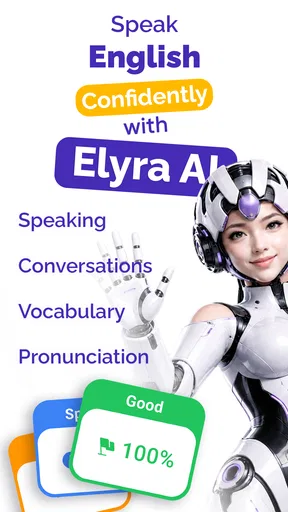
I approached Elyra - AI English Coach as a practical study companion rather than a replacement for a full language course. Developed by Astronex AI, this free education app focuses on spoken English, conversational practice, and vocabulary work with an AI tutor. That combination makes it appealing if you want to practise privately, especially when you do not have a speaking partner ready whenever you are free.
My first impression is that Elyra is most useful when I treat it as a habit-building tool. It is easy to open with a small goal in mind, practise a few phrases, and leave with something concrete to review. The experience feels more personal than reading a word list, but it also demands more active participation than a traditional flashcard app. You need to speak, respond, notice mistakes, and repeat difficult expressions instead of simply tapping through a lesson.
The app is free to install and is rated for Everyone, which makes it approachable for learners at different ages. It has passed the half-million-install mark, so it is not an obscure experiment with no user base. At the same time, its average score of 3.4 shows that the experience will not suit everybody equally. I would recommend trying the free experience carefully before committing to any paid option, particularly because individual in-app purchases range from $9.99 to $179.99.
How I built a useful everyday practice with Elyra
I find Elyra works best when I make each visit serve a small, clear purpose rather than treating it as an open-ended lesson. A useful routine is to choose one real conversation I expect to have, practise expressing the main idea, and note where I hesitated; that gives the next session a practical starting point. With that habit in place, the next question is how to recover when a session feels awkward or unproductive.
A simple starting routine works better than random chatting
The easiest way to get value from Elyra is to begin with one situation instead of asking the app to improve everything at once. I might choose introductions, ordering food, workplace small talk, travel questions, or describing my day. A narrow topic gives the conversation a purpose and makes it easier to notice which words I repeatedly avoid.
For a realistic daily session, I would spend the first few minutes answering naturally rather than trying to produce perfect English. The point is to expose hesitation. If I keep translating from my first language, forget a common verb, or use the same simple adjective repeatedly, that pattern becomes visible during conversation. I then repeat the troublesome sentence with a small change, such as switching the tense or adding a reason.
This is one of Elyra’s strongest uses: it gives a learner a low-pressure place to practise forming answers. A textbook may show a correct dialogue, while an AI tutor can prompt me to create my own version. That difference matters because recognition is easier than recall. I may understand “What did you do yesterday?” when reading it, but answering quickly requires a different skill.
A practical scenario for busy learners
Imagine that I have a short break before commuting. Instead of opening Elyra without a plan, I choose one conversation theme connected to the day ahead. If I have a meeting, I practise explaining a project in plain English. If I am travelling, I rehearse asking for directions and clarifying an answer. If I expect a social conversation, I practise follow-up questions rather than memorising isolated greetings.
After the exchange, I write down three expressions that felt useful and one sentence that felt awkward. I do not try to save every new word. Selecting a small number keeps the session manageable and turns the next practice into a continuation rather than a completely new task. The following day, I try to use those expressions in a different answer so they become flexible language instead of memorised lines.
This workflow also answers an important question about who should use the app: Elyra is a good fit for someone who wants regular speaking exposure but needs privacy or convenience. It is less suitable for a learner who expects a complete, carefully sequenced curriculum without having to decide what to practise.
Use conversation to reveal vocabulary gaps
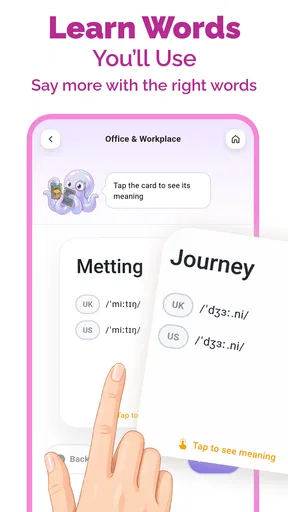
The vocabulary side becomes more valuable when I connect it to speaking. If I learn a word and immediately use it in a sentence about my own life, I have a better chance of remembering how it behaves. I pay attention to combinations, not just definitions. For example, learning a verb is more useful when I also practise the preposition or noun that naturally follows it.
A helpful trick is to ask myself whether I could explain the same idea with simpler words. If I cannot remember “reservation,” can I say “a table I booked”? If I forget a precise adjective, can I describe the object another way? This keeps the conversation moving and builds the skill that real communication requires: recovering from a missing word.
Elyra works well for that kind of recovery practice because the tutor can keep the exchange going. Still, I would not assume that every correction or suggestion should be accepted automatically. AI feedback can be useful as a prompt for reflection, but a learner should check whether a phrase sounds natural in the intended situation. When accuracy matters for an exam, professional writing, or formal communication, a teacher or trusted reference remains the safer final check.
Settings and preparation that prevent wasted sessions
Before settling into a routine, I would check the available app settings and make sure the language level, conversation preferences, and study choices match my actual ability. The exact controls can vary by release, so I would not blindly select the most advanced option just because it sounds ambitious. A setting that makes every exchange overwhelming can discourage practice, while one that is too easy may hide the gaps I need to address.
The current version is 0.3.0, which is an important detail for expectations. Elyra is still at an early stage of development, so I would keep the app updated and remain patient if the interface or learning flow changes over time. Early versions can improve quickly, but they may also feel less polished than mature language platforms with years of refinement behind them.
I also recommend deciding in advance whether a session is for fluency, vocabulary, or correction. Trying to monitor pronunciation, grammar, word choice, speed, and conversation content simultaneously creates mental overload. On one day I might focus on answering without long pauses. On another, I might deliberately use new vocabulary. A clear target makes the same app feel more structured without pretending that it is a complete classroom.
Faster patterns for people who already know the basics
Experienced learners can make Elyra more efficient by using repeatable prompts and situations. Rather than beginning with a vague request to practise English, I would set a constraint: answer in three sentences, explain the same idea to a beginner, disagree politely, or ask two follow-up questions. Constraints force variety and stop the conversation from falling into comfortable phrases.
Another useful pattern is the “answer, expand, repair” cycle. First, I answer quickly with whatever language comes to mind. Next, I add one detail, example, or reason. Finally, I repair one weak sentence by making it clearer or more natural. This creates three kinds of practice in one exchange: speed, elaboration, and accuracy. It is especially useful for learners who can understand English well but freeze when they need to speak.
I would also reuse the same topic on different days with a new purpose. The first session might involve describing a recent experience. The second could require comparing it with an alternative. The third might involve giving advice to someone in the same situation. Repetition with variation is more demanding than repeating an identical dialogue, and it helps vocabulary move from passive recognition into active use.
Shortcuts that improve consistency without inventing complexity
The most effective shortcut is not a hidden button; it is a fixed opening routine. I begin by saying what I want to practise, then I answer naturally, and I finish by selecting a few expressions for later reuse. Because the sequence stays familiar, I spend less time deciding what to do and more time speaking.
I would keep a small external note with three headings: “I knew it,” “I almost knew it,” and “I need it again.” The first group can be ignored for now. The second group contains words I recognised but could not produce quickly, while the last group contains gaps that blocked communication. This prevents me from collecting impressive vocabulary that never appears in real conversation.
A second shortcut is to turn mistakes into prompts for the next session. If I repeatedly use an incorrect tense, I practise a short story that naturally requires that tense. If I avoid questions, I make the next conversation depend on asking for details. This approach is more productive than simply rereading corrections because it places the weak point back into active use.
Where Elyra is better than ordinary alternatives
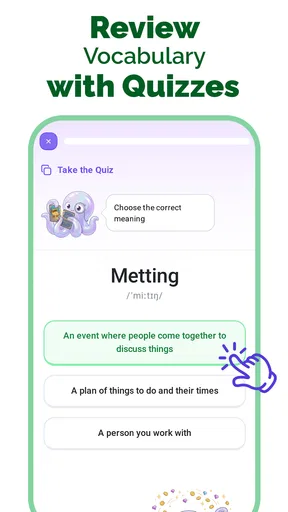
Compared with a standard vocabulary app, Elyra offers a more immediate bridge between knowing a word and using it. Flashcards are excellent for quick recall and spaced review, but they rarely reproduce the pressure of responding to another speaker. Elyra is more useful when my problem is not “I have never seen this word” but “I know this word and cannot retrieve it during a conversation.”
Compared with watching English videos, the app asks me to produce language rather than remain an observer. Videos provide richer accents, cultural context, and natural pacing, so I would not replace them entirely. I would use Elyra before or after viewing: first to prepare useful phrases, or afterward to explain the content in my own words.
A human conversation partner is still better for emotional nuance, spontaneous interruptions, and the subtle reactions that happen in real social situations. A teacher is better for a complete learning plan and dependable explanation of difficult grammar. Elyra’s advantage is availability and privacy. I can practise a specific situation without arranging a lesson or worrying about embarrassing a friend.
Limits that advanced learners should understand
The AI format can encourage a false sense of progress if I only choose comfortable topics. A smooth exchange does not automatically mean that my pronunciation, grammar, or word choice is consistently strong. I need to challenge myself with unfamiliar subjects and longer answers, then verify important language elsewhere.
There is also a trade-off between convenience and depth. An AI tutor can keep a practice session moving, but it may not provide the same carefully staged progression as a dedicated course. Learners preparing for a formal test, following a school syllabus, or needing specialised professional English may want Elyra as a supplement rather than their main resource.
The paid structure deserves attention as well. Since the app is free to install but offers purchases from $9.99 to $179.99 per item, I would explore the accessible parts of the experience before buying anything. The highest-priced option is a substantial commitment for an early-stage app, so I would only consider it after confirming that the conversation style, learning level, and feedback approach genuinely fit my routine.
Device compatibility is relatively broad because the minimum requirement is Android 7.0 or later. That helps people using older Android phones, although the quality of a speaking practice session will still depend on how comfortably the device handles audio input and output. I would choose a quiet place and speak clearly; environmental noise can make any voice-based practice feel less reliable.
Who should choose it, and who should skip it
I would point Elyra toward independent learners who already have a basic foundation and want more chances to speak. It is also a sensible choice for shy learners, people with irregular schedules, and anyone who wants to rehearse a conversation before facing it in daily life. Its value increases when the user is willing to repeat topics, track recurring gaps, and create personal examples.
I would be more cautious about recommending it to complete beginners who need explanations in their first language at every step. I would also steer away from making it the only tool for learners who need a strict course sequence, detailed teacher correction, or official exam preparation. Those users may get better results from a structured class, then use Elyra for extra speaking time between lessons.
The average rating of 3.4 from roughly 547 ratings suggests a mixed public experience rather than universal approval. I read that as a reason to approach the app with a specific goal, not as a reason to dismiss it. A focused speaking tool can be genuinely helpful even when it does not satisfy people looking for a complete language-learning platform.
My final assessment after shaping a repeatable habit
Elyra - AI English Coach is most convincing when I use it for targeted speaking repetitions, vocabulary recovery, and realistic preparation for everyday conversations. Its free entry point makes experimentation easy, and the Everyone rating keeps it accessible to a broad audience. I like the privacy of practising aloud without waiting for a partner, and I find the AI format more active than simply scrolling through word lists.
My recommendation comes with clear boundaries. I would not rely on it alone for advanced accuracy, formal assessment, or a fully organised curriculum. I would pair it with listening practice, reading, and a reliable human or reference source whenever the language has serious consequences. I would also avoid paying for a large purchase until the free experience proves that I will actually return to it.
If I were recommending it to a friend, I would suggest a two-week trial habit: choose one practical topic per session, speak before overthinking, reuse a few expressions, and turn repeated mistakes into the next day’s exercise. That method reveals whether Elyra fits the learner better than a generic download decision ever could. For someone who needs accessible conversation practice and is prepared to guide their own study, it can become a useful part of an English routine. For someone seeking a complete course in one place, another option will probably be the better foundation.
Verdict
Strengths of Elyra: AI English Coach
- Personalized lessons adapt to your English level and learning goals.
- AI conversation practice is available anytime without scheduling a tutor.
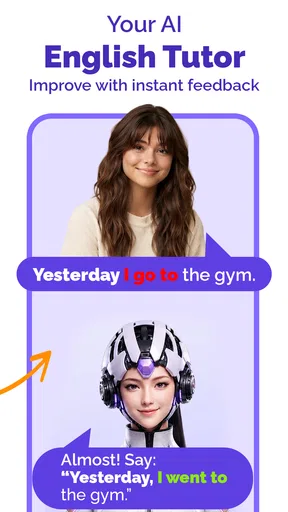
- Instant feedback helps identify grammar, vocabulary, and pronunciation mistakes.
- Short practice sessions make it easy to study during commutes or breaks.
- Progress tracking can help maintain motivation and consistent learning habits.
Limitations of Elyra: AI English Coach
- AI feedback may occasionally misunderstand context or mark valid phrasing as incorrect.
- Advanced speaking features may require a paid subscription or usage limits may apply.
- It cannot fully replace natural conversations with fluent human speakers.
- Some exercises may feel repetitive after extended daily use.
- A stable internet connection may be needed for real-time coaching features.
Similar Picks in This Category
View All
Duolingo: Language Lessons
Duolingo4.7

Google Classroom
Google LLC2.8

Unacademy: Learn & Crack Exams
Unacademy3.2

Bible App for Kids
Life.Church4.4

Cake - Learn English & Korean
Cake Corp.4.7

Brainly: AI Homework Helper
Brainly4.5
Frequently Asked Questions
What is Elyra - AI English Coach, and who is it designed for?
Elyra - AI English Coach is an English-learning app that uses artificial intelligence to support practice with conversation, vocabulary, grammar, pronunciation, and everyday communication. It may be useful for beginners, intermediate learners, and users who want additional speaking practice outside a classroom. Before downloading, check the current app description to confirm which learning levels, languages, and course features are supported on your device.
Can Elyra help me practice English speaking and pronunciation?
The app is primarily intended to make English practice more interactive, particularly through AI-supported conversations and feedback. Depending on the version, it may let you respond by typing or speaking and then provide corrections, suggestions, or explanations. AI feedback can be helpful for building confidence, but it should not be treated as a perfect replacement for a qualified teacher or a natural conversation with a fluent speaker.
Does Elyra - AI English Coach require an internet connection?
Most AI coaching features generally depend on an internet connection because your requests may need to be processed online. Lessons, conversations, corrections, or audio functions could therefore work differently when mobile data or Wi-Fi is unavailable. Users with limited data should review the app’s permissions and store listing, and test whether any lessons or materials can be accessed offline before relying on Elyra while traveling.
Is Elyra free to download, and are there in-app purchases?
Elyra may be available to download at no initial cost, but some advanced lessons, conversation tools, usage limits, or personalized features can require a subscription or an in-app purchase. Pricing, trial periods, and renewal terms may vary by country and platform. Read the payment details carefully before starting a trial, especially if automatic subscription renewal is enabled through Google Play or the App Store.
What privacy information should I consider before using Elyra?
Because Elyra is an AI language coach, the app may process information such as typed messages, voice recordings, learning activity, account details, or device data, depending on the features you use. Before creating an account, review its privacy policy and permission requests to understand how information is stored, shared, and deleted. Avoid entering sensitive personal information into practice conversations unless the policy clearly explains its protection.
